Art Student’s League | NYC
Art Students League of New York: Exploring Abstraction in Jill Nathanson’s Studio/Class One of the things I…
One of the things I love about spending time in New York is having access to the Art Students League. There is something extraordinary about walking into a building where artists have been coming to learn, experiment, struggle, and find their voices for more than 150 years. Founded in 1875 by artists seeking a freer and more independent approach to art education, the League developed around a simple idea: artists learning from artists, with the studio at the center of the experience rather than degrees or rigid academic programs.
Its history is remarkable. Georgia O’Keeffe, Jackson Pollock, Mark Rothko, Louise Nevelson, Helen Frankenthaler, Robert Rauschenberg, Norman Rockwell, Yayoi Kusama and Ai Weiwei are among the many artists who have studied or taught there over the years. In many ways, the history of the League runs alongside the history of modern American art. Yet despite all of that history, it does not feel precious or intimidating when you are there. People are there to work, which may be one of the things I appreciate most about it.
This September, I enrolled in Jill Nathanson’s class, Abstract Painting: Future, Past, Personal. The timing could not have been better for me. My work has been moving steadily toward abstraction, and I have been thinking a great deal about how far I can push that direction without losing the emotional presence that first drew me to landscape.
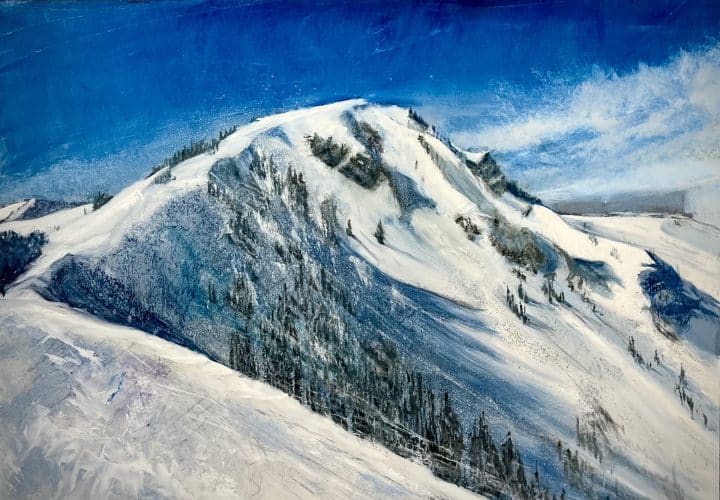
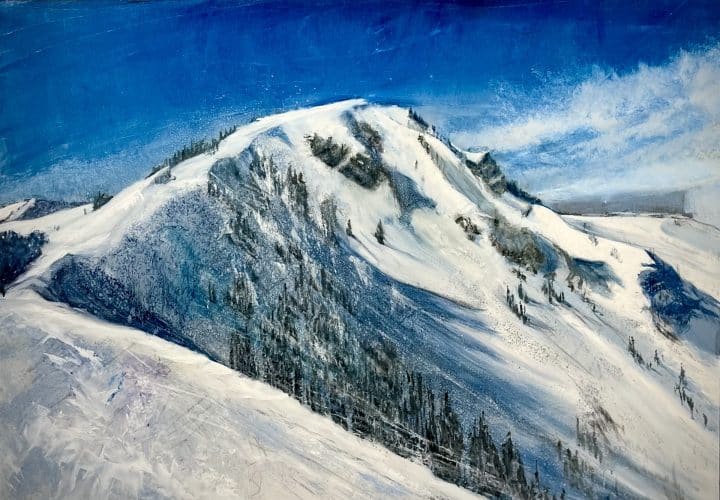
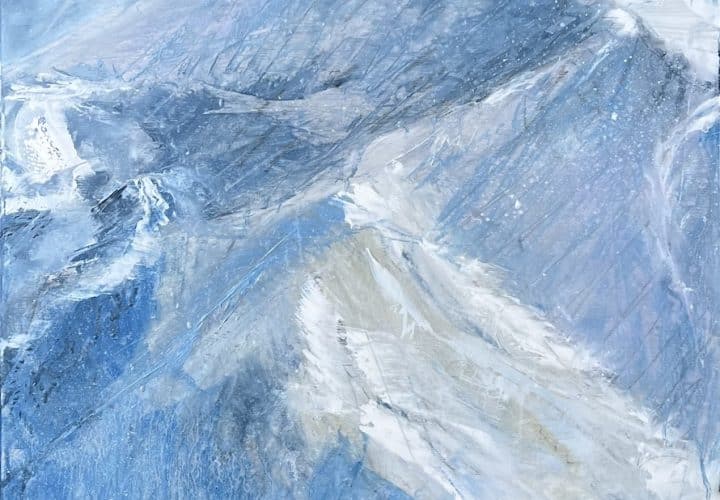
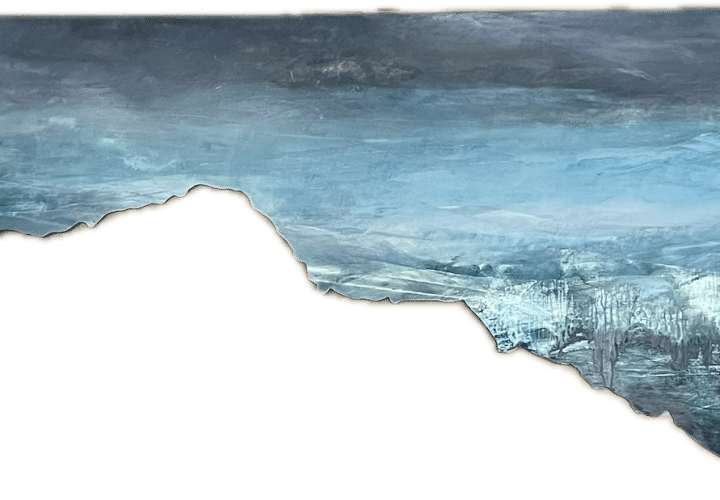
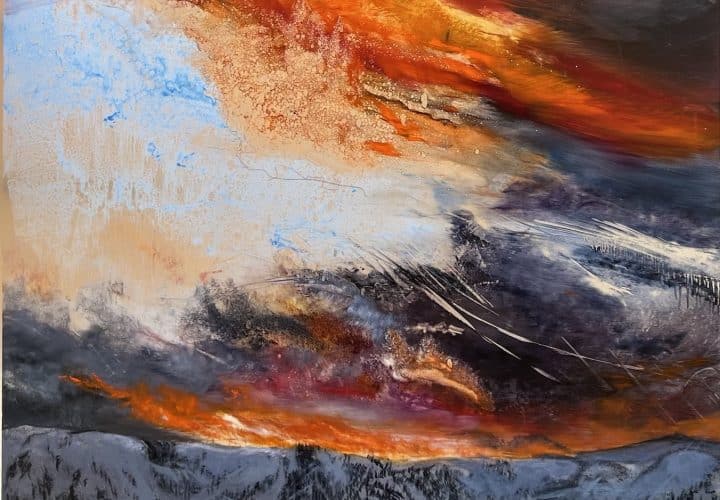
For years, landscape has been my point of departure. Mountains, clouds, storms, changing light and atmosphere give me a structure through which I can explore things that are much less tangible: time, memory, loss, passage, and the possibility that there may be more beyond what we immediately see. Lately, however, I have become less interested in describing landscape and more interested in what happens when I begin to dismantle it. How much can I remove? How little information does the viewer actually need? Can color, transparency, shape and gesture carry the emotional weight that a mountain or cloud once carried for me? Those questions have been very much on my mind during Jill’s class.
One of the most useful exercises has been looking closely at the work of other contemporary abstract painters and using what I observe as a point of departure. I spent time looking at the work of Lex Cyril and Annie Lapin, not with the intention of copying either artist, but as a way of interrupting some of my own habits. When you have worked with landscape for years, even when the work is becoming increasingly abstract, certain compositional instincts become almost automatic. Sometimes it is useful to deliberately begin somewhere else.


In Lex Cyril’s work, I was particularly drawn to the relationship between geometric structure and atmosphere. Rectangles, divisions and hard edges seem to frame or interrupt passages that are much softer and less resolved. I found that tension interesting because it gave me another way of thinking about space. Rather than beginning with a mountain, horizon or cloud formation, I could begin with a shape, an edge, a proportion, or simply the relationship between one field of color and another. That thinking became a point of departure for my first two studies.

In the first painting, I became interested in the idea of an opening within an opening. The rectangular forms establish a kind of architecture, but the softer and more atmospheric color within them begins to undermine that structure. I like the tension between something contained and something less definable. It also connects, perhaps unexpectedly, with ideas that have been appearing in my work for some time: passages, overlapping states, and the suggestion that there might be another space beyond the one we immediately see.

The second painting became much more about disruption. Hard-edged blocks of color meet scraped surfaces, stains and areas that remain unresolved. My instinct is often to create atmosphere and cohesion, so it was useful to let very different kinds of marks remain together without trying to reconcile all of them. I began to think more about the tension between the geometric and organic, the deliberate and accidental, and the constructed and the scraped away.
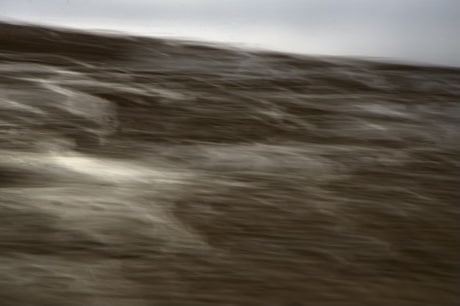
Looking at Annie Lapin’s work opened another door for me. Her paintings often allow fragments of landscape and recognizable imagery to coexist with broad abstract forms, veils and interruptions. The image never completely settles into one kind of space. Instead, representation and abstraction seem to occupy the painting simultaneously.


Work by contemporary painter Annie Lapin, whose layered approach to landscape and abstraction informed exercises during my Art Students League studies.
That ambiguity is something I find increasingly compelling. I am interested in allowing a painting to hover in a place where the viewer thinks they recognize something but cannot quite name it. Perhaps it suggests a cloud, an opening, or light moving through a space that does not actually exist. Or perhaps it does not need to resolve into anything recognizable at all.

In the third study, I pushed further toward simplification. Large areas of red and orange are interrupted by a narrow, irregular passage of pale color, deep blue and green, with a small shard of yellow sitting almost unexpectedly near the top. What interested me was how little information was actually necessary to create movement and a sense of space. It reminded me that abstraction does not necessarily mean adding complexity. Sometimes it means taking enough away that color, shape and spatial relationships have to carry the painting. This began in a horizontal format but when I flipped it on its side, it felt more spacious, like the slot canyons out west.

The fourth study became darker and more contained, with a deep violet-black field, an earthy vertical form, a vivid teal block and a small flash of orange. Again, I found myself thinking less about subject and more about what happens between the forms: how one color pushes against another, how a shape can seem to open or close a space, adding tension, like where the point of pink meets the aubergine edge, and how very small shifts can change the emotional balance of a painting.
These are studies rather than finished answers, and I think that distinction is important. The purpose of taking a class like this is not necessarily to come away with a collection of resolved paintings. For me, it is about disrupting habits and giving myself permission to make things without already knowing what they are supposed to become.
I have been developing a new body of work using transparency, reflection, repetition and forms that suggest openings or passages. My paintings are still connected to the natural world, but I want that connection to become less literal and be more of a feeling the viewer connects with when they look at the work. I am increasingly interested in how much of the recognizable landscape I can remove while still retaining the emotional experience that drew me to landscape in the first place.
The questions I am asking are becoming less about what a place looks like and more about what a painting can suggest. Can an abstract form behave like an opening? Can two different kinds of space exist within the same painting? Can transparency suggest time, memory, or another plane of experience? I do not have answers to those questions yet, but the work I have been doing at the League this month has reinforced my desire to keep experimenting.
There is something wonderfully appropriate about doing this kind of searching at the Art Students League. It began because artists wanted the freedom to pursue their own ideas rather than follow a prescribed path, and more than 150 years later, artists are still walking into those studios for essentially the same reason. That is certainly why I am there.
I don’t know exactly where these experiments will lead, and for the moment I don’t particularly want to know. That uncertainty may be one of the most valuable parts of the process. Sometimes the next direction in a body of work begins not with knowing what you want to paint, but with giving yourself permission to see differently.